Shelving Sag Risk Estimator
Enter your shelf specifications to see the sag risk analysis.
Analysis Result:
Key Takeaways
- Hardwoods like Oak and Walnut are naturally more rigid than softwoods or composite boards.
- Plywood is generally stiffer than MDF or particle board due to its cross-grain layers.
- The "Sagulator" logic proves that span length is just as critical as the wood type.
- Adding a hardwood edge (cleat) can stop a cheaper board from bowing.
Why Your Shelves Sag in the First Place
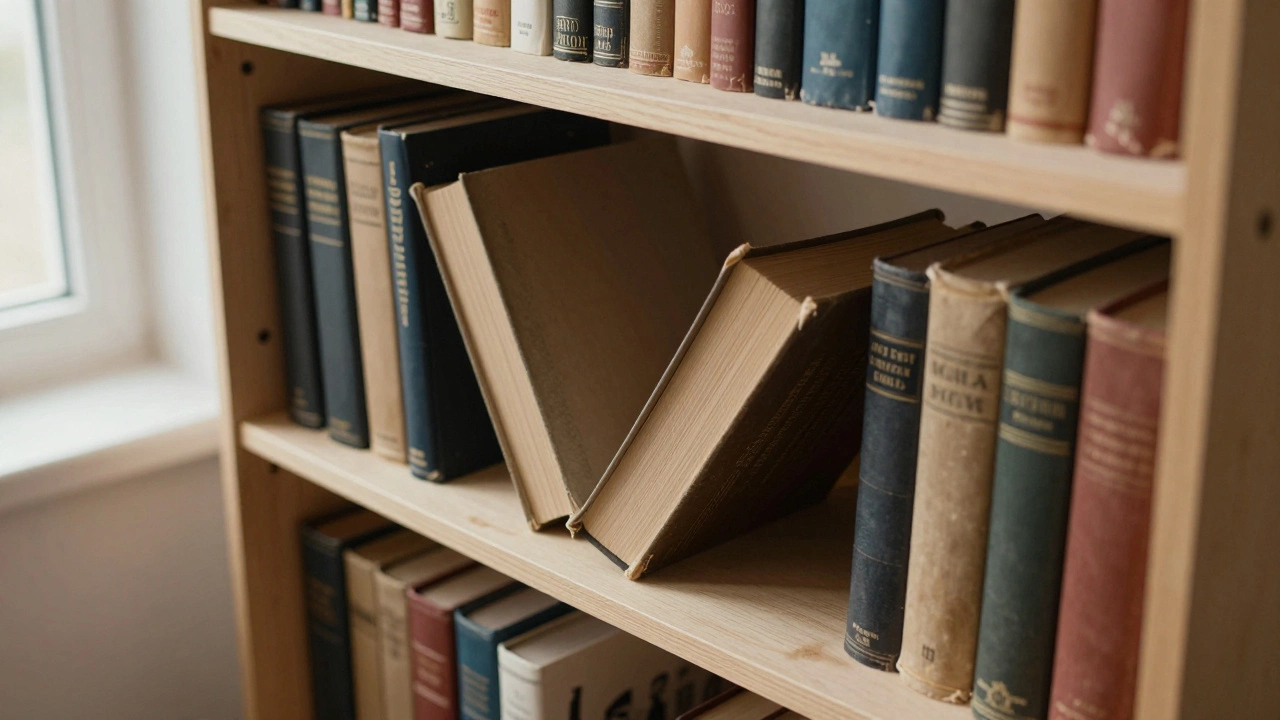
Before we pick the wood, we need to talk about why this happens. In the world of woodworking, we look at something called the modulus of elasticity. Basically, it's a measure of how much a material will bend before it permanently deforms. When you put a heavy load on a board, the fibers on the top compress and the fibers on the bottom stretch. If the wood isn't stiff enough, it reaches a point of no return.
Most people make the mistake of using MDF is a medium-density fiberboard made from broken-down wood fibers combined with wax and resin. While it's cheap and flat, it has almost no internal structure. It behaves more like a very dense sponge than a piece of timber. If you put a 30-inch span of 3/4-inch MDF under a set of encyclopedias, it will almost certainly bow within a year.
The Heavy Hitters: Hardwoods That Resist Bending
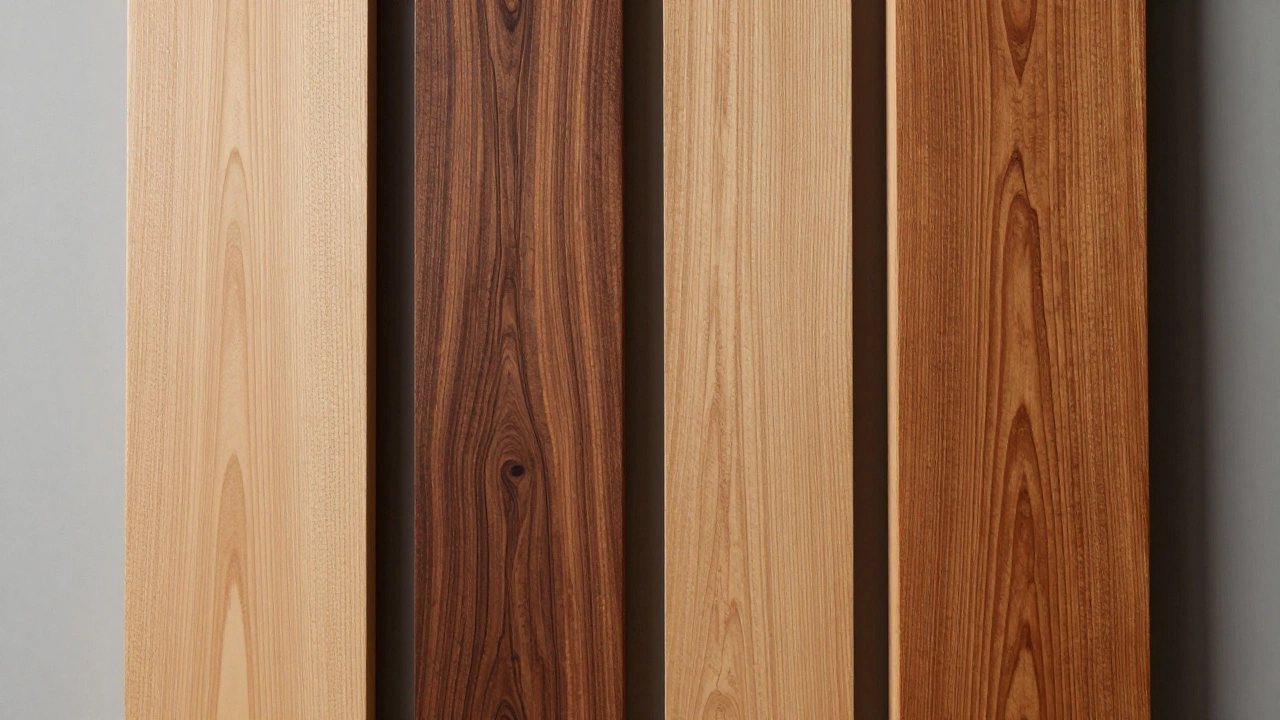
If you want a shelf that stays dead-flat for decades, you go for hardwoods. These are dense, tight-grained woods that can handle significantly more weight over longer spans. Oak is a dense hardwood known for its strength and prominent grain, commonly used in high-end furniture. It is the gold standard for shelving because of its high stiffness-to-weight ratio. Whether you use Red Oak or White Oak, you're getting a board that resists compression much better than pine.
Then there is Walnut is a premium hardwood prized for its dark color and excellent dimensional stability. While slightly more expensive, Walnut is incredibly rigid. If you are building floating shelves where there is no support in the middle, Walnut is your best friend. Similarly, Maple is an extremely hard, light-colored wood with a tight grain that makes it nearly impervious to sagging. Maple is often used in butcher blocks for a reason-it's tough as nails.
| Material | Stiffness Level | Best Use Case | Sag Risk |
|---|---|---|---|
| Oak/Maple | Very High | Heavy Books, Long Spans | Very Low |
| Plywood (Birch) | High | Closets, Pantry Shelves | Low to Medium |
| Pine | Medium | Light Decor, Small Rooms | Medium |
| MDF/Particle Board | Low | Painted Cabinets (Short Spans) | High |
The Plywood Alternative: Strength Through Layers
You don't always need a solid slab of Oak. Plywood is an engineered wood formed by gluing together thin layers of wood veneers with the grain of each layer running perpendicular to the next. This cross-lamination is a genius move for shelving. Because the grains are crossing, the board doesn't have a single "weak direction" like solid pine does.
For the best results, look for Baltic Birch Plywood is a high-grade plywood featuring more layers (plies) and fewer voids than standard construction plywood. A 18mm sheet of Baltic Birch is significantly stiffer than a standard piece of pine from a big-box store. If you're building a pantry and need to hold heavy cans of soup, this is usually the most cost-effective way to get professional strength without spending a fortune on exotic hardwoods.
Softwoods and the "Pine Trap"
Many DIYers start with Pine is a soft, lightweight wood commonly available in construction lumber because it's cheap and easy to find. But here is the catch: pine is a softwood. Its cell structure is much more open and airy than oak. This makes it flexible. While flexibility is great for a bow or a ski, it's terrible for a shelf.
If you absolutely must use pine-maybe for a rustic look-you have to compensate with thickness. A 1-inch thick pine board will sag where a 3/4-inch oak board wouldn't. You can also reduce the span. Instead of one long shelf, use two shorter ones with a center support. If your span is over 30 inches and you're using pine, you're essentially gambling with your books.
Pro Tricks to Prevent Sagging Regardless of Wood
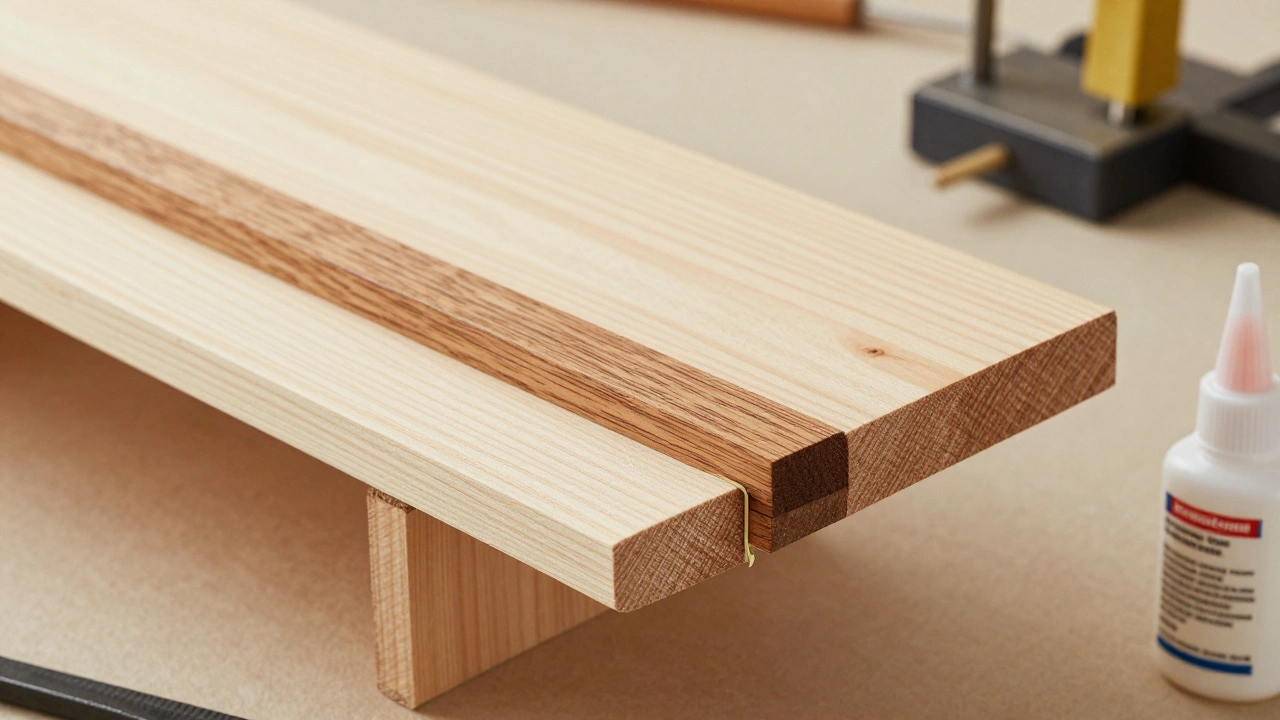
What if you've already bought the wood and realized it's too flimsy? Or maybe you want the look of a cheaper wood but the strength of a hardwood. You can "cheat" the physics. One of the oldest tricks in the book is adding a stiffener. This is a strip of hardwood glued and screwed to the front edge of the shelf.
Think of it like an I-beam in a skyscraper. By adding a 1.5-inch strip of oak to the front of a pine shelf, you create a structural rib that resists bending. The glue bond between the hardwood strip and the main shelf creates a composite beam that is vastly stronger than either piece alone. This allows you to use cheaper materials in the center while maintaining a crisp, straight line at the front.
Another key factor is the span length. No matter what wood you choose, there is a limit. A general rule of thumb is that for most hardwoods, you shouldn't exceed a 36-inch span without some form of center support. For MDF, that number drops to about 24 inches if you're carrying any real weight. If you're designing a wall-to-wall library, don't try to do it with a few massive boards; break it up with vertical dividers (stiles) every 2 to 3 feet.
Common Pitfalls to Avoid
One of the biggest mistakes is ignoring the moisture content. Wood is hygroscopic, meaning it absorbs water from the air. If you put a shelf in a damp garage or a steamy bathroom, the wood softens. This lowers its stiffness and accelerates the sag. Always seal your wood with a polyurethane or varnish to lock out moisture.
Another error is relying solely on bracket strength. People often buy heavy-duty steel brackets and assume that because the bracket can hold 200 lbs, the shelf won't sag. The bracket only supports the ends. The sag happens in the middle of the board, regardless of how strong the brackets are. You need to focus on the material's stiffness, not the hardware's load capacity.
Will a thicker board always stop sagging?
Generally, yes. Increasing the thickness of a shelf has a massive impact on stiffness. Doubling the thickness of a board doesn't just double the strength-it can actually make it exponentially more resistant to bending. However, thickness can't save a very poor material. A thick piece of particle board will still sag more than a thinner piece of high-quality oak over a long period.
Is plywood better than solid wood for shelves?
It depends on the type of plywood. High-grade birch plywood is often more stable than solid wood because it doesn't warp or shrink as much with temperature changes. However, a solid slab of oak or maple is typically stiffer than standard construction plywood. For most home projects, Baltic Birch plywood is the best balance of strength, cost, and stability.
How do I fix a shelf that has already started to sag?
If the sag is minor, you can try adding a support cleat-a piece of wood screwed into the wall that the shelf rests on along its entire back edge. If the sag is severe, the only permanent fix is to replace the board with a stiffer material or add a vertical support in the center of the span to redistribute the weight.
What is the best wood for a heavy-duty pantry?
For a pantry holding heavy jars and cans, 3/4-inch Baltic Birch plywood is the ideal choice. It's incredibly strong and resists bowing. If budget is no object, solid Maple is the absolute strongest option for high-density storage.
Does the grain direction matter for shelving?
Absolutely. Wood is strongest along the grain. This is why you always want the grain to run lengthwise across the shelf. If the grain runs the wrong way, the board will have almost no structural integrity and will fold under the slightest pressure.
Next Steps for Your Project
If you're just starting your build, your first move should be to measure your intended span. If you're going over 36 inches, don't even look at MDF or Pine. Head straight for Oak or Birch Plywood. If you're on a budget, buy a cheaper wood but plan for a center support or a hardwood edge strip.
For those who are unsure about the weight of their items, a good rule of thumb is to assume books weigh about 20-30 lbs per foot of shelving. Use this estimate when deciding if you need to move from a "medium" stiffness wood to a "high" stiffness hardwood. When in doubt, go thicker-it's much easier to sand down a board that's too thick than it is to fix a shelf that has bowed into a curve.