Curtain Harmony Checker
Curtain Coordination Assessment
Check if your curtains are harmoniously coordinated based on the key principles in the article. Select options for each attribute to see if your window treatments work together.
Select options above to check your curtain coordination.
Ever walked into a room and felt something was off-even though everything looked expensive or stylish? More often than not, the culprit isn’t the furniture or the paint. It’s the curtains. One pair is crisp linen, another is heavy velvet with tassels, and the third? It’s a cheap polyester blind someone forgot to take down. It doesn’t scream "bad taste." It just feels… off. That’s because curtains aren’t just window coverings. They’re the finishing touch that ties a room together-or pulls it apart.
Why curtain consistency matters more than you think
People think curtains are like socks: if they’re clean and cover the window, who cares if they match? But curtains don’t just block light. They shape how a room feels. They control airflow, reduce noise, and even affect how warm or cool a space seems. And visually? They’re the largest fabric element in most rooms. If your living room has a modern sofa, minimalist coffee table, and neutral walls, but one window has flowy floral curtains and another has blackout roller shades, your eye doesn’t know where to rest. It jumps. It gets tired. And your brain starts to feel unsettled.
Studies in environmental psychology show that visual harmony reduces stress. A room with consistent window treatments feels more intentional, more calming. That’s not just interior design fluff-it’s science. You don’t need every curtain to be identical, but you do need them to feel like they belong to the same family.
When to match curtains exactly
There are times when matching curtains is the only smart move. If your room has one dominant window-say, a large bay window in the living room or a floor-to-ceiling window in the bedroom-go all in. Match the curtains on all panels of that window. Use the same fabric, same length, same hardware. It creates a sense of grandeur. Think hotels, high-end boutiques, or luxury apartments. They don’t mix and match on focal windows. They unify.
Same goes for rooms with symmetry. If you have two identical windows across from each other, mismatched curtains break the balance. Your brain expects mirroring. When it doesn’t get it, the room feels unstable. That’s why designers always match curtains on paired windows in dining rooms, bedrooms, or home offices. It’s not about being boring. It’s about respecting the architecture.
When it’s okay to mix curtain styles
But here’s the truth: not every room needs perfect symmetry. In open-plan spaces-like a kitchen that flows into a living area-you might have different window types. A small kitchen window next to a tall living room window? Trying to make them match exactly can look forced. That’s where layering and coordination come in.
You can use sheer curtains in the kitchen for light and privacy, and blackout linen panels in the living room for comfort and style. The trick? Keep the color family close. If your living room curtains are warm gray, choose a cream or oat-colored sheer for the kitchen. Same texture? Even better. Both are natural fibers. Same hanging style? Even better. Both use rod pockets or tabs. You’re not matching. You’re harmonizing.
Another common scenario: a bedroom with a window and a sliding door. You don’t need the same curtain on both. But you can use the same fabric on the window and a simpler, solid panel on the door. Or use the same lining. Even if the outer layer differs, matching the lining creates a subtle cohesion that people notice without realizing why.
The three rules of curtain coordination
Here’s how to make sure your curtains work together-even if they’re not identical:
- Stick to one color family. Don’t throw in a blue curtain next to a red one unless you’re going for a bold, intentional contrast. Stick to neutrals, or pick one base color and use variations in tone. A deep navy with a lighter sky blue? Fine. Navy and lime green? Not unless you’re designing a circus tent.
- Match the weight and texture. Heavy velvet with lightweight cotton? That’s a mismatch. Curtains should feel like they’re from the same season. If your main curtains are thick and lined for winter, the others should be too-or you need a layering strategy (like adding sheers underneath). Mixing textures is fine, but only if they belong together. Linen and cotton? Yes. Silk and burlap? No.
- Keep the length consistent. Curtains should either all pool on the floor, all hover ½ inch above, or all stop at the windowsill. Mixing lengths creates visual chaos. Pooling looks luxurious. Sill-length looks practical. But mixing them? It looks like you gave up.
What about blinds and shades?
Blinds, shades, and shutters aren’t curtains-but they’re part of your window treatment system. You can mix them, but again, with rules. If you have roller shades in a home office and linen curtains in the bedroom, that’s fine. But if you have wooden blinds in the living room and plastic shades in the kitchen, the contrast feels cheap. Instead, pick a material family. Use woven wood shades in both rooms. Or use white cellular shades in both. Even if one is a shade and the other is a curtain, keeping the base material consistent creates unity.
And don’t forget hardware. The rod, the finials, the rings-they’re part of the look. If one window has brass rods and another has matte black, your eye catches that. It’s a distraction. Stick to one metal finish across the room. Brushed nickel? Go all in. Oil-rubbed bronze? Use it everywhere. It’s a small detail, but it makes a big difference.
Real-life examples that work
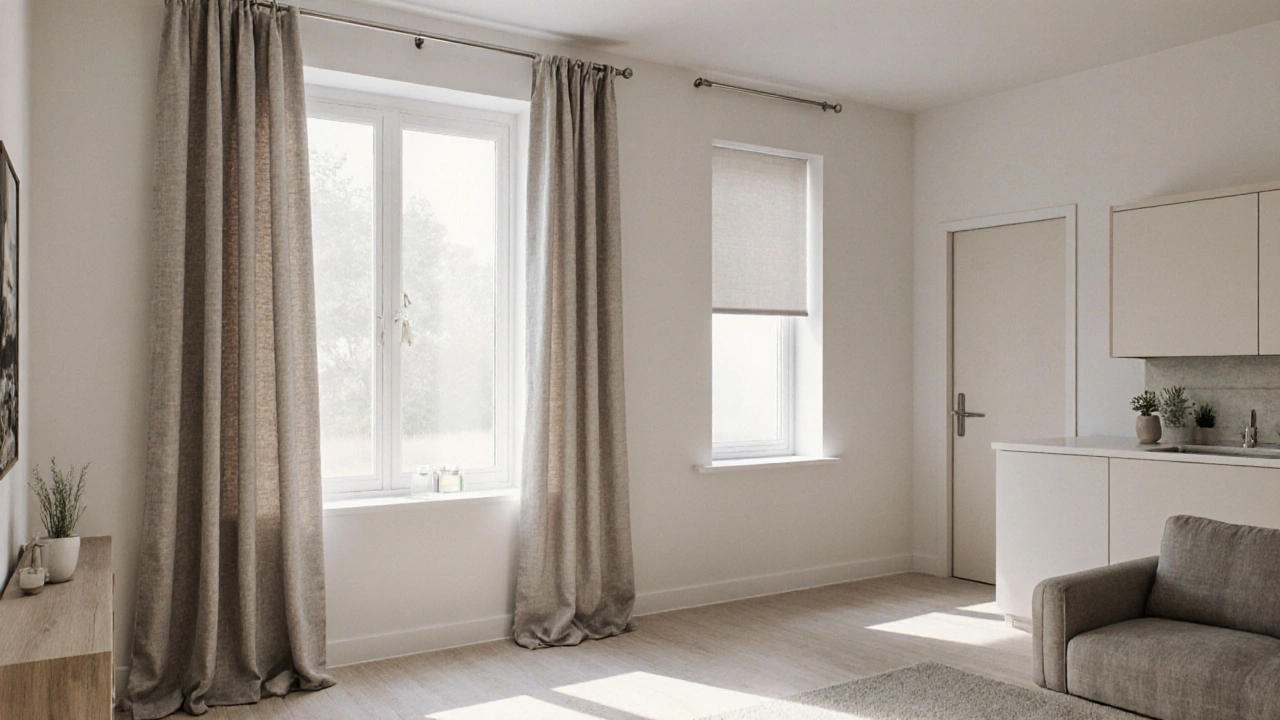
Take a modern apartment with three windows: a large living room window, a narrow bathroom window, and a small kitchen window. The living room has floor-to-ceiling, floor-pooling linen curtains in a soft taupe. The bathroom has a simple white cotton roller shade. The kitchen has a sheer linen panel that matches the living room fabric but stops at the sill. All three use the same rod finish-brushed nickel. The linen in all three ties them together. The length difference is intentional: practical for the kitchen and bathroom, luxurious for the living room. The result? A cohesive, intentional look-not matching, but deeply connected.
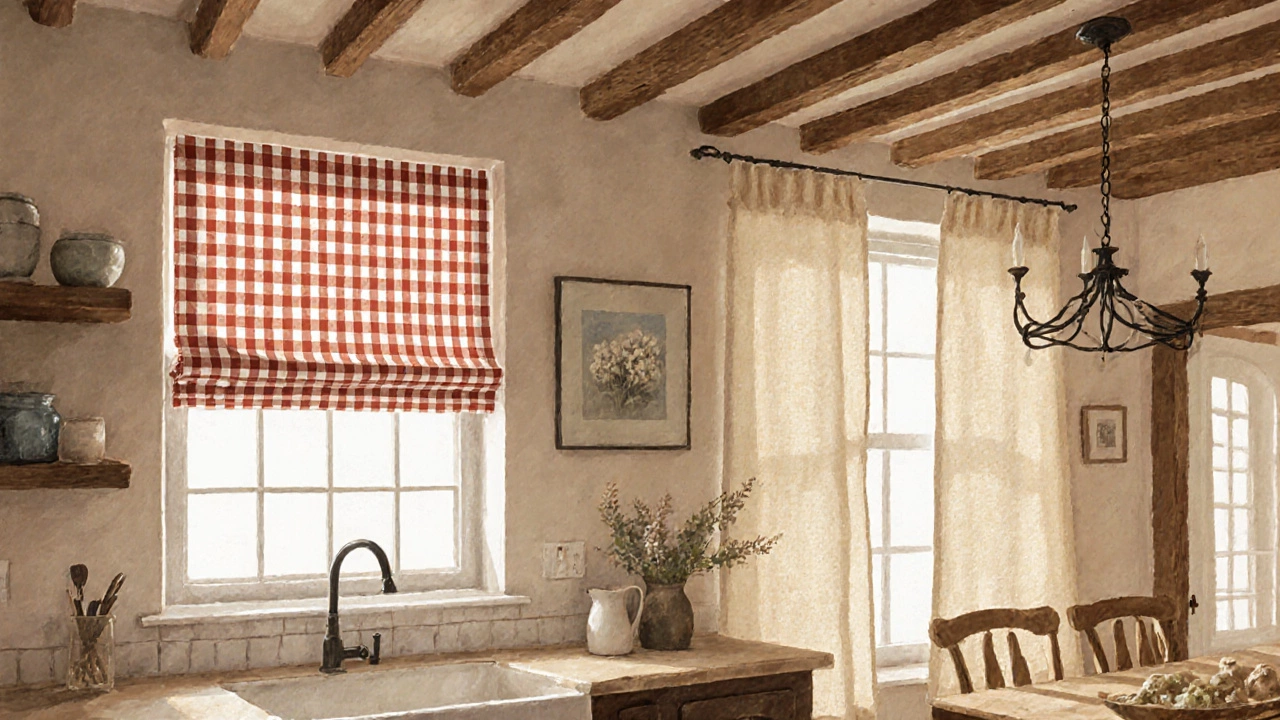
Another example: a farmhouse-style kitchen with a window over the sink and a window next to the dining area. The sink window has a gingham cotton curtain. The dining window has a solid linen panel in the same cream color. The gingham adds charm. The linen adds calm. The shared color and fabric weight make them feel like siblings, not strangers.
What happens when you ignore these rules?
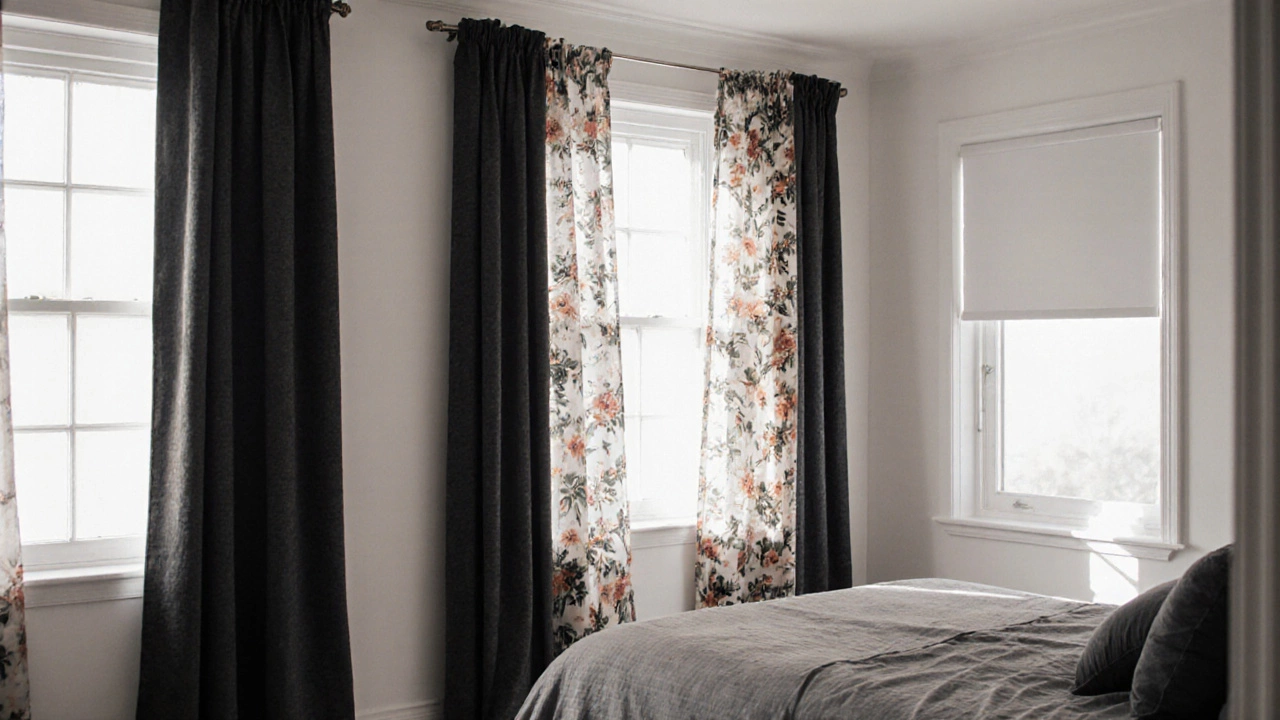
Imagine a bedroom with three windows. One has heavy blackout curtains in charcoal. One has a floral voile. One has a plain white roller blind. The room has white walls, a gray bed, and a wooden dresser. Now step back. What do you see? Not a bedroom. You see a collection of window treatments that don’t know each other. The eye doesn’t relax. The room feels unfinished. Even if every piece is high quality, the lack of harmony makes the whole space feel low-budget.
This isn’t about perfection. It’s about intention. People don’t notice perfect curtain matching. But they notice when something’s missing. When the room feels disjointed. When the curtains look like an afterthought.
Quick checklist for curtain harmony
- Are all curtains in the same color family? (Yes/No)
- Do they use similar fabrics or textures? (Yes/No)
- Are they all the same length? (Yes/No)
- Is the hardware consistent? (Yes/No)
- Do they serve a similar function? (e.g., all for privacy, all for light control)
If you answered "No" to two or more, it’s time to rethink. You don’t need to buy new curtains. You might just need to swap out one piece. A simple change-like replacing a mismatched blind with a sheer panel that matches your main curtains-can transform the whole room.
Final thought: It’s not about matching. It’s about belonging.
Curated spaces don’t look like catalogs. They look lived-in. But they also feel intentional. Curtains are one of the easiest ways to add that sense of care. You don’t need to match them exactly. But you do need to make sure they’re part of the same story. Think of them as chapters in the same book-not the same chapter, but written by the same author, in the same tone.
When your curtains belong together, the room breathes easier. And so do you.
Do all curtains in a house need to match?
No, curtains don’t need to match across the whole house. But within each room, they should feel coordinated. A living room can have linen curtains in beige, while the bedroom has blackout cotton in gray. That’s fine. What doesn’t work is mixing wildly different styles, colors, or textures within the same room. Keep harmony room by room, not house-wide.
Can I mix curtain patterns in one room?
Yes-but carefully. You can mix patterns if they share the same color palette and scale. For example, a small stripe on one curtain and a large floral on another can work if both use navy and cream. But don’t pair a bold geometric with a busy paisley. The clash will overwhelm the space. Stick to one dominant pattern and use solids or subtle textures for the rest.
Should curtains match the sofa or walls?
Not necessarily. Curtains should complement the room, not copy it. Matching curtains exactly to your sofa can feel too matchy-matchy. Instead, pull a color from the rug, an accent pillow, or even the artwork. That creates a layered, intentional look. If your walls are white and your sofa is blue, try curtains in a soft gray that ties into both.
What if I have odd-shaped windows?
Odd shapes like arches or angled windows don’t need the same treatment as standard rectangles. Use a custom shade or roman blind for the odd window, and match the color and material of the curtains on the standard windows. The goal isn’t identical treatments-it’s visual balance. A simple, clean shade next to flowing curtains can work if the colors and textures are aligned.
Can I use different curtain lengths in the same room?
It’s not recommended. Mixing lengths-like one curtain pooling on the floor and another stopping at the sill-creates visual confusion. If you need practicality in one area (like a kitchen), use a sheer panel that stops at the sill, but match the fabric and color of the longer curtains elsewhere. The consistency in material and hue keeps the room feeling unified, even if the length differs.