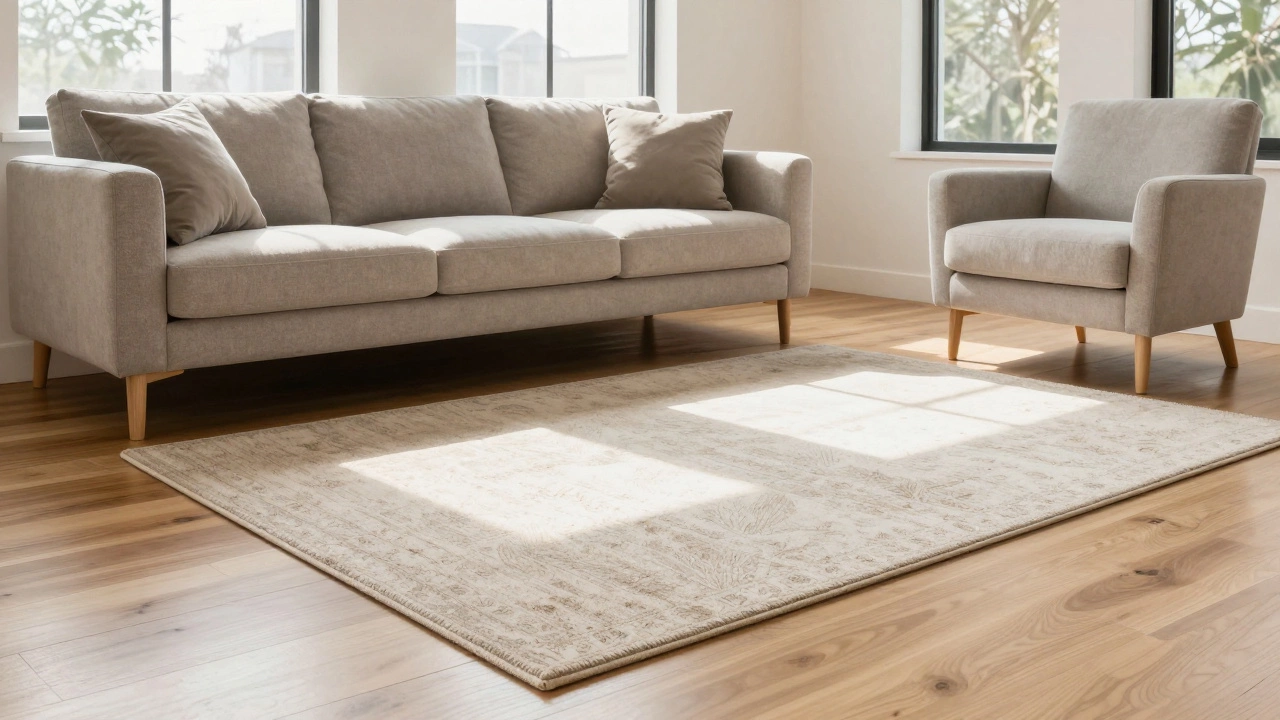
Ever stood in the middle of your living room, staring at a tiny rug that looks like it got lost on the way to the coffee table? You’re not alone. Many people buy rugs thinking bigger is better - but then wonder why the space still feels off. The question isn’t just should a rug fill the whole floor? It’s: what does the right rug actually do for your room?
Why a rug that covers everything isn’t always the answer
A full-floor rug sounds ideal - like a carpet that hugs every edge, leaving no bare wood or tile exposed. But in modern homes, that’s rarely the right move. Most houses today have beautiful hardwood, stone, or polished concrete floors. Covering them entirely with a rug kills the visual rhythm of the space. It makes rooms feel heavy, dated, or even smaller.
Think about it: if every surface is covered in pattern or texture, your eyes have nowhere to rest. A well-placed rug should frame your furniture, not hide your floor. The goal isn’t to eliminate the floor - it’s to highlight it.
How big should a rug really be?
There’s a simple rule most interior designers use: your rug should fit under all the main furniture legs - not just the front two. That’s the sweet spot. In a living room, that usually means a rug at least 8x10 feet. In a bedroom, it should extend 18 to 24 inches past each side of the bed.
Here’s what that looks like in practice:
- Living room: A 9x12 rug lets the front legs of your sofa and chairs sit on it, with the back legs hovering just off. This creates a grounded, connected seating area.
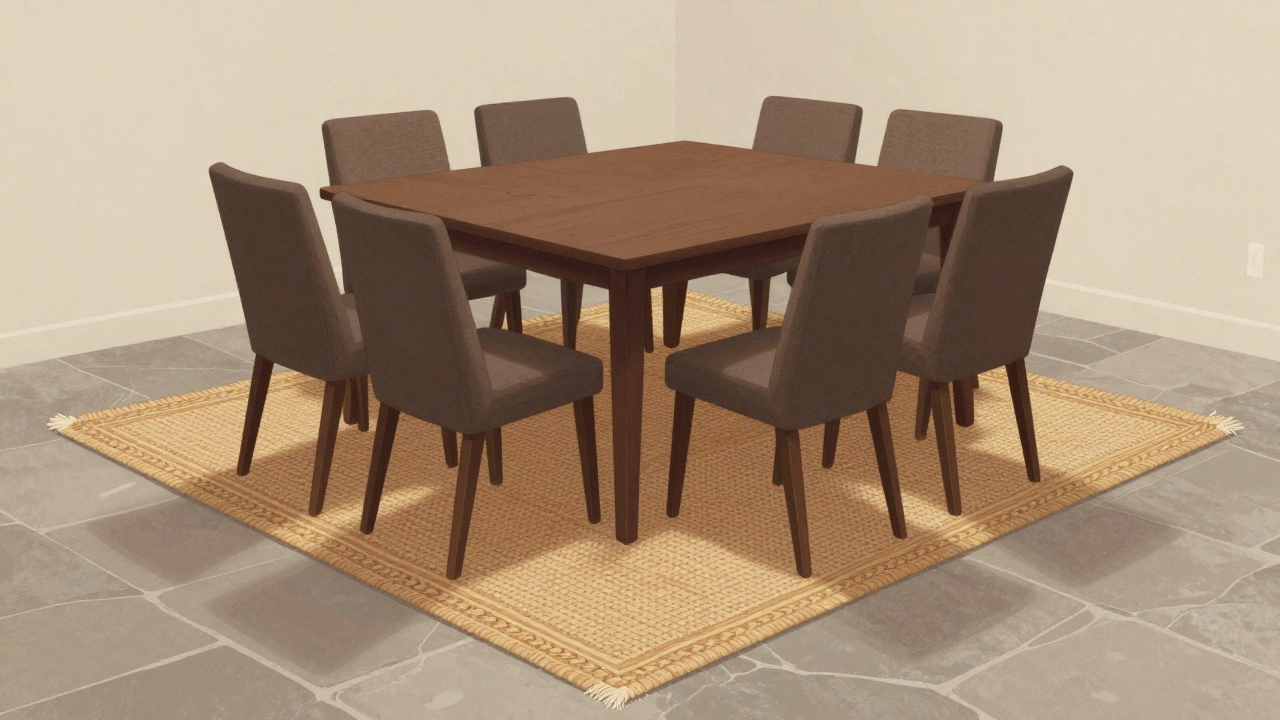
- Dining room: The rug needs to be large enough so that when chairs are pulled out, all four legs stay on the rug. A 10x14 rug is often perfect for a standard six-seat table.
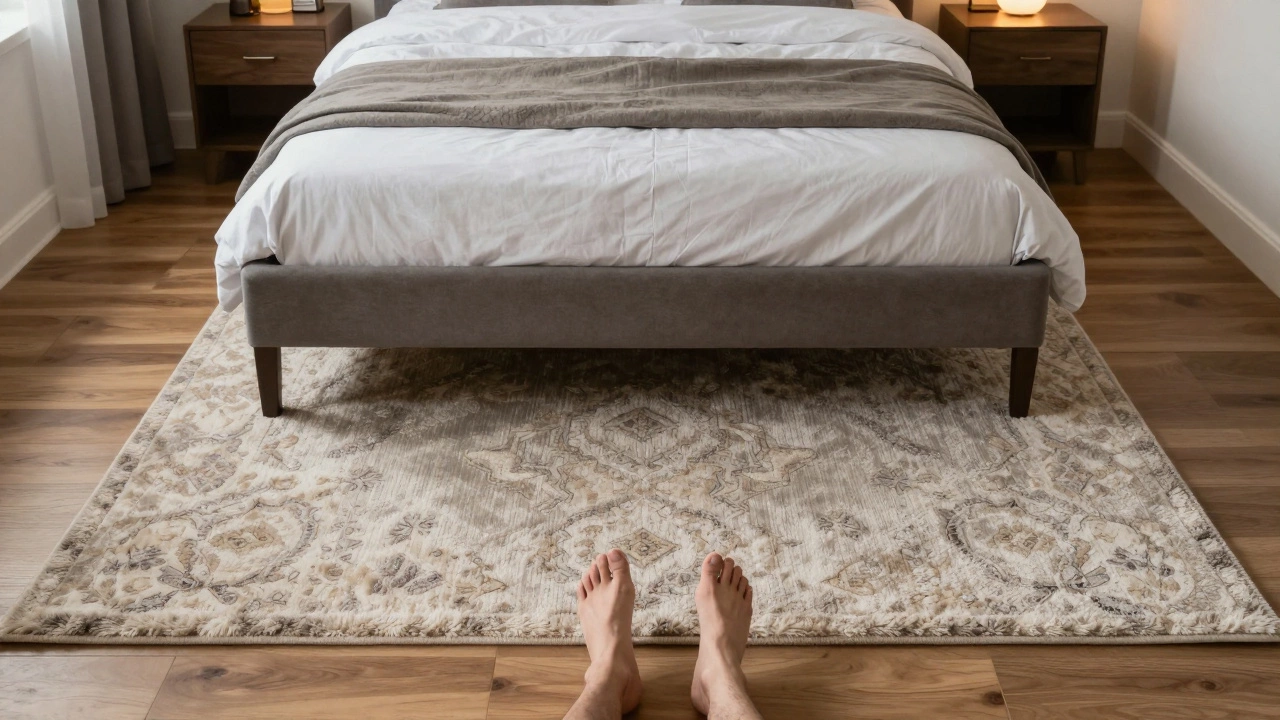
- Bedroom: A rug under the bed with 18-24 inches showing on all sides gives a soft landing for bare feet. If you have a king-sized bed, go for a 9x12 or 10x14.
- Small spaces: In a studio or compact living area, a 5x8 rug under the front legs of your sofa and coffee table can define the zone without overwhelming it.
These aren’t guesses - they’re based on how people actually move through rooms. If your rug is too small, your furniture looks like it’s floating. Too big, and you lose the sense of scale.
What about pattern and texture?
Size isn’t the only thing that matters. A rug with a bold pattern can make a room feel smaller if it’s too large. A busy floral or geometric design on a 12x15 rug in a 10x12 room? That’s visual noise. Stick to subtle textures or low-contrast patterns for larger rugs. Save the bold prints for smaller, accent rugs.
Texture matters, too. A thick, shaggy rug in a high-traffic area like a hallway or entryway is a bad idea - it traps dirt and is hard to clean. A low-pile wool or flatweave works better there. In bedrooms or lounging areas, go for something plush. Your feet will thank you.
When does a full-floor rug actually work?
There are exceptions. Full-floor rugs - sometimes called room-sized carpets - make sense in three situations:
- Older homes with dated flooring: If your floor is scratched, stained, or has mismatched planks, a large rug can unify the look. This is common in historic British homes, where original floorboards are uneven.
- High-end luxury spaces: In penthouses or designer homes, a custom-made, hand-knotted rug that spans the entire floor can be a statement piece. Think of it like a painting on the floor.
- Rooms with no other flooring: If you have concrete or unfinished subflooring, a full rug is practical - and sometimes necessary.
Outside those cases? Skip it. Most modern homes benefit from contrast - between the rug and the floor, between texture and smoothness, between color and neutrality.
How to measure your space the right way
Don’t just guess. Grab a tape measure and do this:
- Sketch your room layout. Include doors, windows, and fixed furniture.
- Mark where your main seating or bed will sit.
- Draw the rug size you’re considering. Then, imagine pulling out chairs or walking around the bed. Do legs stay on? Is there enough room to move?
- Use painter’s tape to outline the rug on the floor. Walk around it for a day. Does it feel right?
This step takes five minutes, but it saves you from buying a rug that’s too big - or too small - and having to return it. Most rug returns cost £20-£50 in shipping. That’s money you don’t need to waste.
What rug materials work best?
Not all rugs are created equal. Here’s what to look for:
- Wool: Durable, naturally stain-resistant, and soft underfoot. Best for living rooms and bedrooms. Comes in natural tones or rich dyes.
- Flatweave (like kilim or dhurrie): Thin, reversible, and easy to clean. Great for high-traffic areas like hallways or kitchens.
- Synthetic (polypropylene, nylon): Budget-friendly and moisture-resistant. Good for basements or kids’ rooms. But they don’t last as long as wool.
- Hand-knotted: Expensive, but timeless. These can last 50+ years. Worth it if you’re buying for the long term.
Avoid rugs with rubber backings unless they’re specifically designed for hard floors. Rubber can stain or damage wood over time.
Common mistakes people make
Even experienced shoppers mess up. Here are the top three errors:
- Buying based on online photos: A rug that looks huge on a 15x20ft loft might look tiny on your 12x14ft room. Always check dimensions in feet, not pixels.
- Ignoring the door swing: If your rug extends under a door that opens inward, it’ll catch and fray. Leave at least 1 inch of clearance.
- Choosing color to match the sofa: That’s not how it works. Match the rug to your walls or floor instead. A beige rug with gray walls creates calm. A charcoal rug with white walls creates drama.
Final thought: It’s not about covering space - it’s about defining it
A rug isn’t meant to be a floor blanket. It’s a frame. A boundary. A soft landing. The best rugs don’t try to hide the floor - they make you notice it. They draw people into the space. They invite you to sit, to linger, to feel grounded.
So no - you don’t need a rug that fills the whole floor. But you do need one that fits your life. Measure twice. Walk around. Live with the layout. Then choose.
Can I layer two rugs to get the right size?
Yes - and it’s one of the best ways to fix a rug that’s too small. Place a neutral, flatweave rug (like a jute or sisal) down first as a base. Then layer a smaller, patterned rug on top. This adds depth and makes the space feel intentional. Just make sure the bottom rug is large enough to anchor the top one. Avoid thick pile-on-pile combos - they’re slippery and hard to clean.
What if my room is an odd shape?
Odd-shaped rooms - like L-shaped living rooms or rooms with alcoves - need custom thinking. Use two smaller rugs instead of one big one. Place one in the main seating zone and another in a reading nook or dining corner. This breaks the space into functional zones without forcing a single rug to stretch awkwardly. Always keep the rugs aligned with the room’s natural flow.
Do I need a rug pad?
Always. A rug pad isn’t optional - it’s essential. It prevents slipping, reduces wear on the rug and floor, and adds cushioning. For hardwood floors, choose a felt-and-rubber combo. For tile or stone, go with non-slip rubber. A good pad costs £15-£30, but it doubles the life of your rug. Skip it, and you’ll be replacing the rug sooner than you think.
How often should I replace my rug?
It depends on the material and traffic. A high-quality wool rug in a low-traffic bedroom can last 20-30 years. A synthetic rug in a busy hallway might need replacing every 5-7 years. Look for signs: thinning fibers, fading, or slipping even with a pad. If the rug looks worn under the couch or near the door, it’s time.
Can I use a rug in the kitchen or bathroom?
Yes - but only if it’s designed for it. In the kitchen, use a flatweave or rubber-backed mat that’s easy to wipe clean. Avoid shag or wool. In the bathroom, choose a quick-drying, non-slip rug made of microfiber or cotton. Keep it small - just enough to step onto after a shower. Never use a large rug in a wet area. Moisture leads to mold, and mold ruins rugs - and floors.