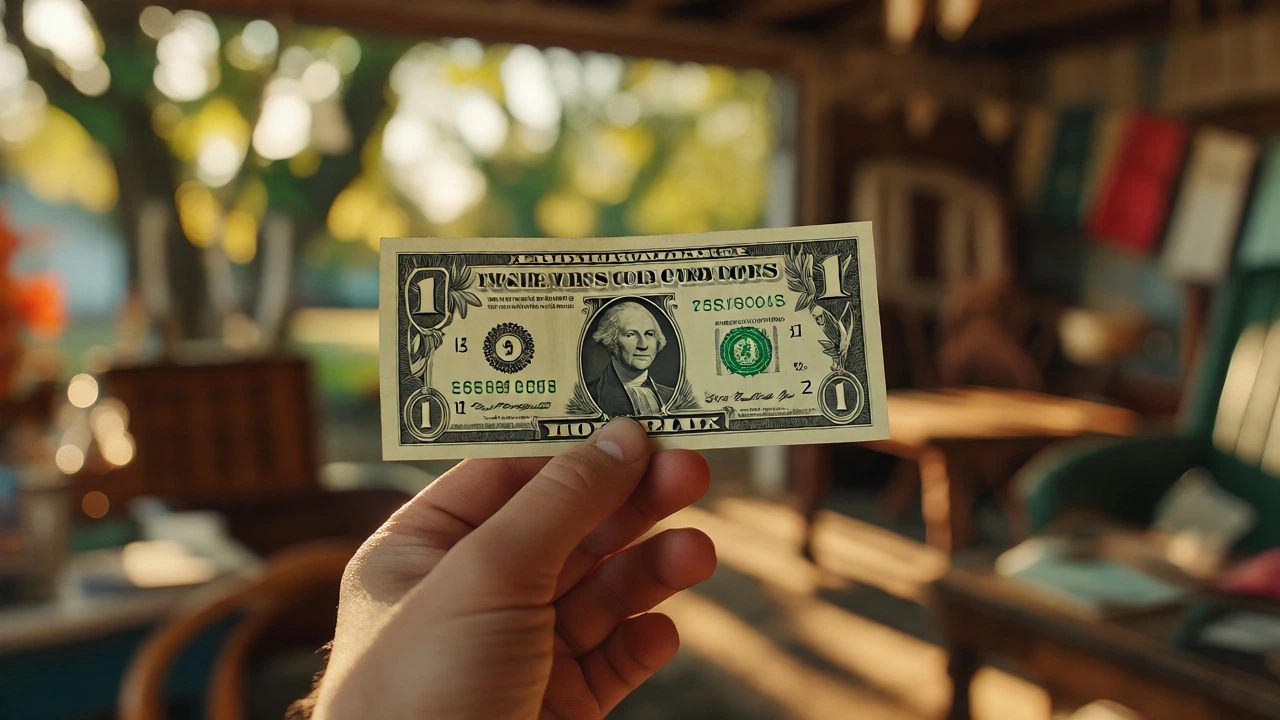
US Dollar Slang Explorer & Quiz
Click on a term below to learn its origin and usage. Then, try the quiz to see if you can match the slang to the denomination!
Quick Quiz: Match the Slang
Loading question...
You’re at a garage sale in Ohio, and the seller points to an old lamp. "Ten bucks," he says. You hand over a crisp ten-dollar note. But what if you only had singles? Would you say, "Here’s ten ones"? Or would you use something more colorful? If you’ve ever wondered what is slang for a $1 bill, you’re not alone. Americans have a long history of giving their currency nicknames that range from the mundane to the bizarre.
The most common answer you’ll hear today is simple: it’s just called a "dollar." But dig deeper into regional dialects, historical contexts, and pop culture references, and you’ll find a treasure trove of terms like "buck," "simoleon," or even "dead president." Why do we talk about money this way? It usually comes down to trust, humor, or trying to sound tough. Let’s break down exactly what people call that greenback in your pocket, where those names came from, and which ones are actually still used in 2026.
The Most Common Terms: Buck and Dollar
If you ask ten random Americans on the street what they call a single dollar bill, nine will likely say "a buck." The other might say "a dollar." These two terms dominate modern usage because they are short, punchy, and universally understood across the United States. But why "buck"?
The term dates back to the early days of the American frontier. In the late 18th and early 19th centuries, deerskins were a primary form of trade goods among settlers and Native Americans. A prime male deer skin was worth one unit of value, while a female or fawn skin was worth less. Over time, "buck" became synonymous with the standard unit of currency. When the U.S. government established the dollar as the official currency, the slang stuck. It’s a classic example of how economic necessity shapes language.
While "dollar" is the official term, using it can sometimes feel formal or stiff in casual conversation. Saying "That coffee cost me three dollars" sounds correct but slightly distant. Saying "That coffee cost me three bucks" feels immediate and real. This shift in tone is why slang persists. It connects the transaction to human interaction rather than abstract accounting.
Historical and Archaic Slang Terms
Not all slang survives the test of time. Some terms fade into obscurity, surviving only in movies or books set in the past. Others linger as nostalgic references. If you watch films from the 1930s or read hardboiled detective novels, you’ll encounter words that define a specific era of American money talk.
One such term is "simoleon." This word emerged during World War I when American soldiers were stationed in France. They needed a way to refer to their currency without confusing it with French francs. "Simoleon" sounded vaguely foreign yet distinctly American. It gained popularity through comic strips and radio shows in the 1940s. Today, no one under the age of sixty uses it seriously. However, you might hear it used ironically by older generations or in period dramas to establish authenticity.
Another relic is "greenback." This term originated during the Civil War when the Union issued paper money backed by the federal government rather than gold or silver. The reverse side of these notes was printed in green ink to prevent counterfeiting. Unlike gold coins, these bills had no intrinsic metal value, making them purely fiat currency. The name "greenback" highlighted this visual distinction. While still recognized, it’s rarely used in daily commerce. You’re more likely to see it in news headlines discussing monetary policy than in a checkout line.
Regional and Niche Variations
American English isn’t monolithic. Slang often depends on where you are and who you’re talking to. In some regions, specific terms carry local weight. For instance, in parts of the South, you might hear "one-spot" referring to a single dollar bill. This comes from the visual appearance of the number '1' on the bill. It’s informal and mostly heard among older residents or in rural communities.
In urban centers, particularly within hip-hop culture and street vernacular, terms like "band" (for $1,000) or "grand" are common, but for smaller amounts, speakers often stick to numbers or generic terms like "cash." However, there are playful variations. "Dead presidents" is a humorous reference to the portraits on larger bills, but since George Washington appears on the $1 bill, some people jokingly refer to it as "George." This personification adds character to the currency. Instead of handing over a piece of paper, you’re handing over "George." It’s a small linguistic trick that makes transactions feel less sterile.
College campuses also generate their own micro-slang. Students might refer to a dollar as a "single" to distinguish it from a "double" ($2 bill, which is rare) or a "five" ($5 bill). This shorthand speeds up communication in dorm rooms and cafeterias. It’s functional slang-designed for efficiency rather than flair.
Why Do We Use Slang for Money?
You might wonder why we don’t just stick to the official terminology. After all, banks and governments use precise language. The answer lies in social signaling. Language does more than convey information; it establishes identity and relationships.
Using slang creates intimacy. When you tell a friend, "I’m out of bucks," it signals shared experience and informality. Using formal terms can create distance. Imagine a boss saying, "Please return the funds to my desk." Now imagine them saying, "Can you put the cash back on my desk?" The latter feels approachable. Slang lowers barriers.
Additionally, slang allows for euphemism. Discussing money can be awkward, especially regarding debt or poverty. Saying "I’m broke" or "I’m short on cash" feels different than "I lack sufficient funds." Slang provides emotional cushioning. It softens the blow of financial reality. For the $1 bill specifically, calling it a "buck" removes the bureaucratic weight of the word "dollar," making the concept feel everyday and manageable.
Other Currency Nicknames in Context
To fully understand the place of the $1 bill in slang, it helps to look at its neighbors. How do we talk about other denominations? This comparison reveals patterns in how Americans view value.
| Denomination | Formal Name | Common Slang | Origin/Context |
|---|---|---|---|
| $1 | Dollar | Buck, Single, George | Frontier trade units; visual cues |
| $5 | Five Dollar Bill | Fiver, Lincoln, Sawbuck | Lincoln portrait; "Sawbuck" refers to Roman numeral X shape |
| $10 | Ten Dollar Bill | Tenner, Hamilton, Fiver (rare) | Hamilton portrait; "Tenner" is British-influenced |
| $20 | Twenty Dollar Bill | Score, Jackson, Double Sawbuck | "Score" means twenty; Jackson portrait |
| $100 | Hundred Dollar Bill | C-note, Benjamin, Grand | Franklin portrait; "C" stands for Century |
Notice how higher denominations often have more colorful names. "Grand" for $1,000 implies magnitude. "Benjamin" for $100 personalizes the wealth. The $1 bill, being the smallest unit, has simpler names. It’s utilitarian. We don’t romanticize the dollar the way we do the hundred. It’s workhorse currency.

Is Slang Changing in the Digital Age?
We live in an era of digital payments. Venmo, Apple Pay, and credit cards dominate transactions. Fewer people physically handle paper money. Does this affect slang?
Surprisingly, yes, but not in the way you might expect. Physical slang terms persist because they are deeply embedded in cultural memory. People still say "It costs five bucks" even if they pay with a phone. The phrase conveys value more quickly than "It costs five units of USD." However, new terms are emerging around digital balances. Phrases like "digital dust" or "app balance" are starting to appear, though they haven’t replaced traditional terms.
For the $1 bill specifically, its role is shrinking. Many retailers now accept contactless payments for small purchases. Vending machines take cards. As physical dollars become rarer, the slang associated with them may become more nostalgic. Younger generations might learn "buck" from parents or media rather than from direct experience. Yet, language moves slowly. "Buck" has survived centuries of economic change. It’s unlikely to disappear anytime soon.
How to Use These Terms Correctly
If you want to sound natural in American conversations, here’s a quick guide. Stick to "buck" or "dollar" for general use. They are safe, clear, and widely accepted. Avoid "simoleon" unless you’re joking or writing fiction. Use "single" if you need to specify quantity clearly, such as when breaking a large bill.
Be mindful of context. In a job interview, say "salary" or "wage," not "bucks." At a barbecue, "bucks" fits perfectly. Slang is a tool for social calibration. Using it correctly shows you understand the unspoken rules of the setting. Misusing it can make you seem out of touch or overly familiar.
Remember, language evolves. What’s cool today might be cringe tomorrow. But the core desire behind money slang-to connect, to simplify, to express-is timeless. Whether you call it a dollar, a buck, or a dead president, the value remains the same. The words are just wrappers for the trust we place in our economy.
Why is a dollar called a buck?
The term "buck" originates from the colonial era when deerskins (buckskins) were used as a medium of exchange. A prime male deer skin represented one unit of value. When the US dollar was established, the slang term persisted due to its familiarity and brevity.
Is "simoleon" still used today?
Rarely. "Simoleon" is considered archaic slang, popularized in the mid-20th century through comics and radio. Modern speakers typically use it for comedic effect or to evoke a retro atmosphere, not in serious financial discussions.
What is the most polite way to refer to money?
In professional or formal settings, use "dollar," "funds," or "currency." Avoid slang like "bucks," "cash," or "money" if you want to maintain a neutral, respectful tone. "Dollar" is the safest choice for clarity and politeness.
Do other countries have similar slang for their currency?
Yes. In the UK, pounds are often called "quid." In Australia, dollars are referred to as "bucks" or "smackers." In Canada, a dollar coin is known as a "loonie" due to the loon bird depicted on it. Every culture develops its own colloquialisms for money.
Why is the $1 bill called a "greenback"?
During the Civil War, the US issued paper currency with green ink on the reverse side to deter counterfeiting. Unlike gold-backed coins, these bills relied on government decree. The distinctive green color led to the nickname "greenback," which remains a recognizable, albeit dated, term.